GrillMe
Finishing, and the review
The interviewer offers to finish when it has nothing left to ask. A person confirms, with the interviewer’s own sentence, or the operator finishes earlier with Finish now. Then the team reviews the ticket, with the changes the AI proposes from the answers.
The offer to finish
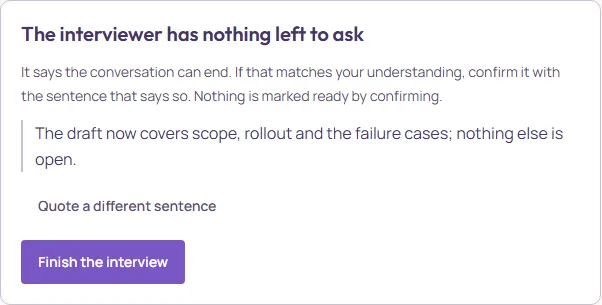
Below the question card sits a line, The interviewer offers to finish when it has nothing left to ask. When it does, the line becomes a card with the sentence in which the interviewer said so. The operator reads it, and if it matches the team’s understanding, presses Finish the interview. Quote a different sentence picks another sentence from the reply if the first one is not the one that says it.
The operator can also finish before the offer, with Finish with a sentence you choose: the interviewer has to have said the conversation is over somewhere.
Or the operator ends the interview before the interviewer is done, with Finish now. It asks once, Finish the interview now?, and Keep answering or Escape goes back to the questions. Once finished, the ticket is prepared from what was said so far and marked incomplete, and the questions nobody answered stay open in it. A failure, a limit or a cancellation does not end an interview: those pause it, and the answers stay.
Finished
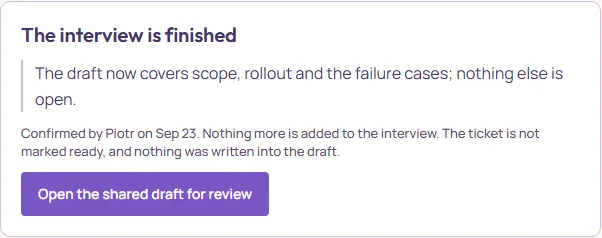
The card records who confirmed and when. Nothing more is added to the interview, and nothing was written into the draft. Open the shared draft for review is for the host, or the operator: it takes everyone back to the Editor, where the document is now Refined. Guests read “The host opens the shared draft for review and export.” If the host has no plan, the button opens the plan choice instead; a guest sees a sentence asking the host to choose one.
The final version prepares itself as soon as the interview is confirmed: the card says Preparing the final version…, and then the Editor opens in review with the proposed changes. It is paid from the host’s points. If it cannot start, for example because the host has too few points, the card says why and offers Retry to the host or the operator; the interview stays as it was. An interview too long for the AI to read in one go gets no Retry, because it would be refused again: the card says so, no points are spent, and the host or the operator reviews the draft and marks it ready, so the draft is the final version.
The review
The review is the same Editor, with the review column beside the document and a band above it: how many decisions from the interview were applied, and how many open questions are still to decide. The final version is the changes the interview justifies, proposed by the AI; they arrive as suggestions, one row per change, and the host or the operator approves or rejects each one exactly as in the draft (Review changes: suggestions and comments). Two panels beside the document keep what did not make it into the text:
- Left for a later discussion
- Questions the interview parked or did not settle. They are not silently turned into decisions.
- Your discussion, your decisions
- The answers the team gave, with who gave them, so the ticket can cite them.
- Accept final version
- Approves every change of the final version that is still pending, as one decision on Undo after reopening, and marks the ticket Ready. If the document was edited since the final version was prepared, it says so first and accepts only after you confirm you have read the changes; if a change no longer fits the text, nothing is approved and that change is marked out of date for you to read.
- Mark ready
- Without a final version, locks the ticket for hand-off. The workspace switcher shows Ready and every editing tool greys out. Reopen for edits unlocks it.
Then export: Markdown, HTML, Word, the clipboard or Print, from Tools (Invite, export, close). An interview that was interrupted exports too, marked incomplete, so nothing said is lost.
Marking the ticket ready does not close the document. A document stays until its host deletes it; closing only ends access and can be undone. Export when you want a copy outside Scopeleaf.